

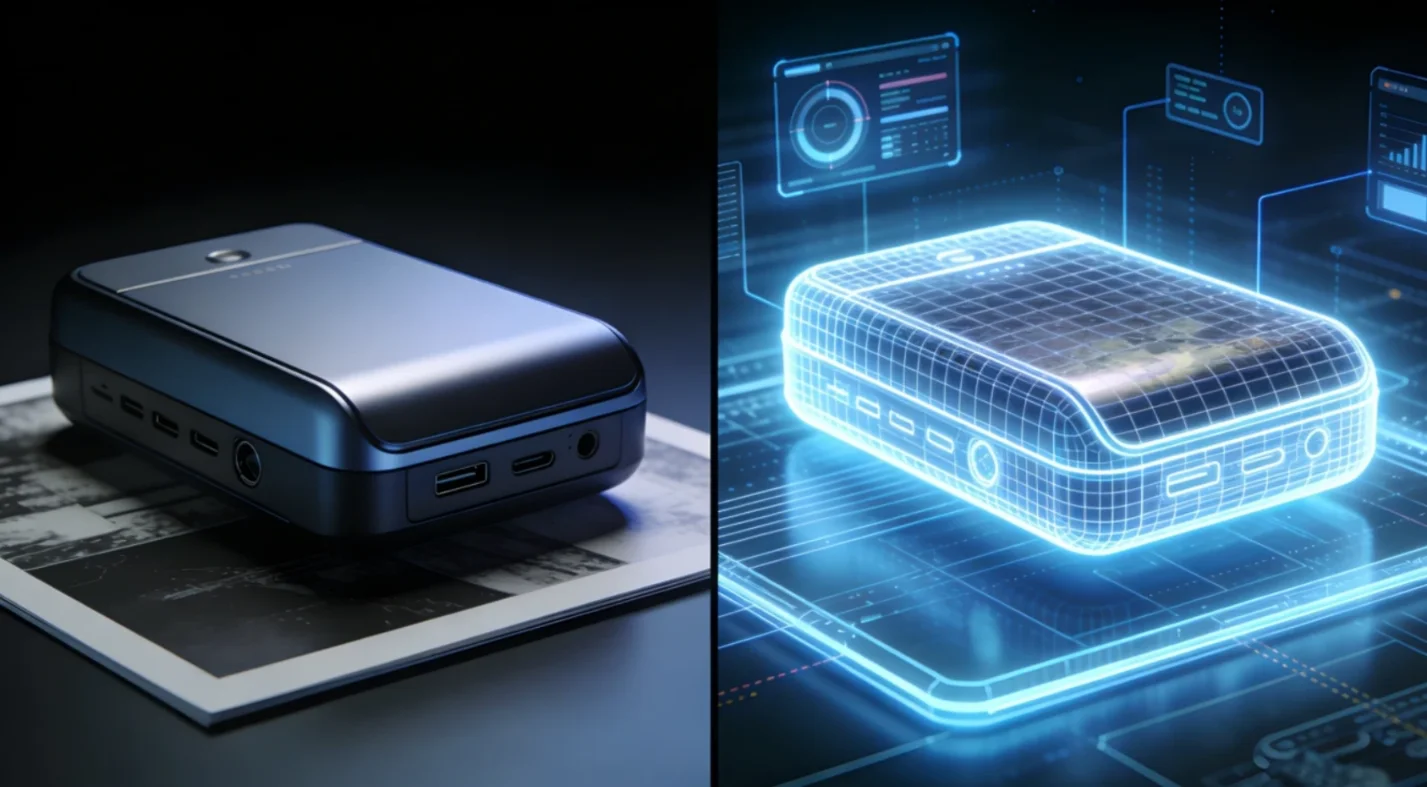

Interactive 3D product displays significantly increase conversion rates. Traditional 3D modeling takes weeks and destroys budgets. Merchants with massive SKUs cannot afford manual workflows. The solution is automation. Scaling a 3D product catalog requires abandoning manual modeling for automated pipelines. By integrating an enterprise-grade image to 3D AI tool like Neural4D, merchants can convert standard 2D photos into spatial assets in seconds.
The Bottleneck in E-commerce 3D Adoption
❌ The Cost of Manual Retopology
Traditional 3D outsourcing bills by the day. Manual vertex pushing, UV unwrapping, and retopology consume massive amounts of time. Converting thousands of SKUs requires an enterprise-level budget. Small and mid-sized merchants simply cannot compete under the old asset generation model.
❌ The Failure of Early AI Generators
Early AI outputs were practically unusable. They generated triangle soup with non-manifold geometry. You cannot drop these unoptimized files into Three.js or WebGL engines. They inflate draw calls and crash the browser renderer. E-commerce platforms need structured geometry, not visual approximations.
What Defines a Production-Ready 3D Pipeline?
✅ Mathematically Watertight Meshes and Clean Topology
E-commerce assets demand deterministic output. The geometry must be stable. Not all generators are built for production environments. When engineering teams areevaluating the best image-to-3D models for their pipeline, the primary metric is whether the output is engine-ready without requiring manual cleanup. Tools powered by modern algorithms, specifically Neural4D’s Direct3D-S2 engine, provide mathematically watertight geometry. The walls have actual thickness. The topology is quad-dominant.
✅ Pure Albedo and PBR Workflows
Web rendering requires accurate light reactions. Flat colors fail in digital storefronts. A usable mesh must strip baked-in lighting from the original 2D photo. It must provide pure albedo and standard PBR maps. This workflow ensures the product looks correct under any digital store lighting environment.
Automating the Catalog: How to Deploy AI at Scale
⚡ API Integration and Batch Inference
Stores with massive inventories cannot generate models one by one. Pipeline integration is mandatory. Development teams connect to enterprise APIs for batch inference. Merchants upload their 2D directories to the server. Systems like Neural4D process the data in parallel and output unified .glb or .gltf assets ready for immediate web deployment.
🎯 Iteration via Natural Language
Sometimes a generated asset needs a slight material adjustment. Modern multimodal AI, such as the conversational interface in Neural4D-2.5, allows store operators to tweak scale or textures using simple text prompts. You do not need a 3D artist to fix a specular map. You type the command, and the model updates instantly.
Shifting from Static to Spatial Asset Pipelines
Automated 3D asset generation is now an industrial standard. Relying on manual modeling limits your catalog visibility and inflates your overhead. Deploying a production-ready AI pipeline trades compute power for visual dominance. Upgrading your workflow to include deterministic 3D generation is the only way to process inventory at a modern scale.